

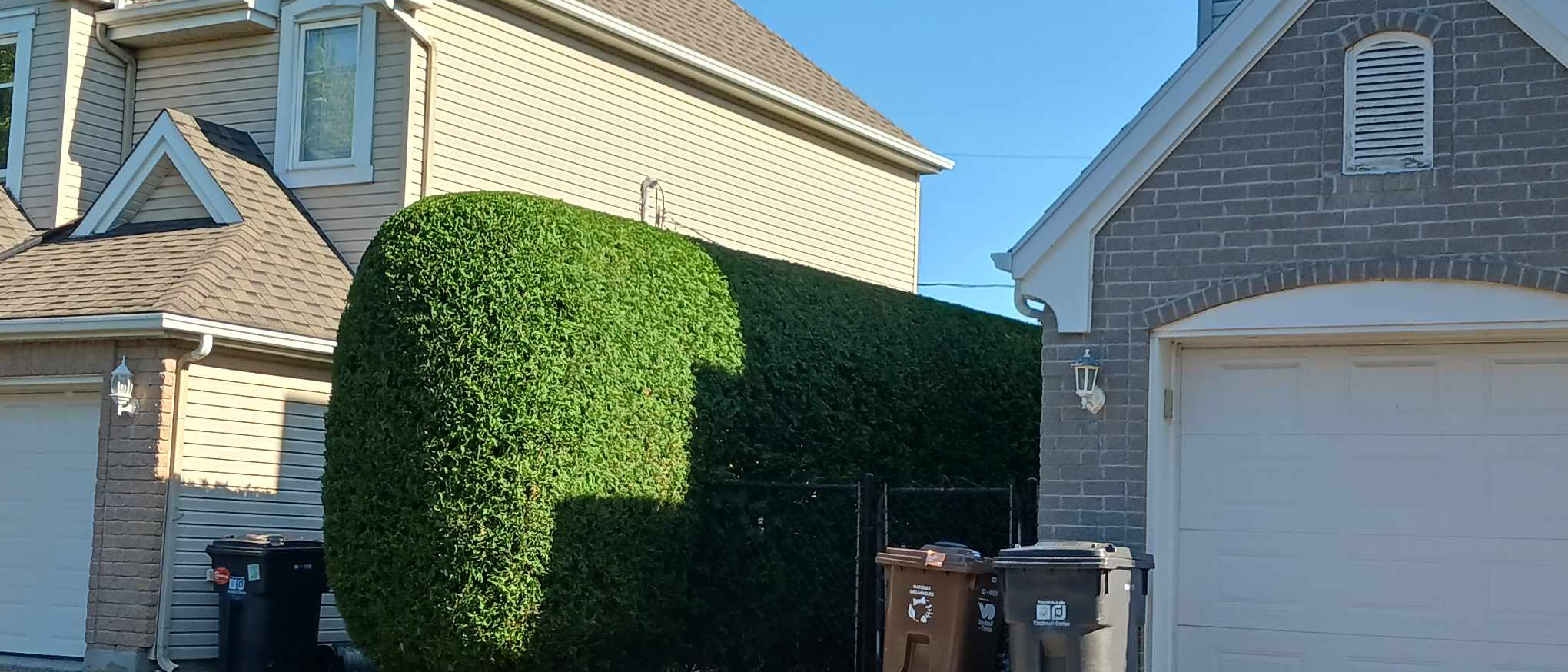
Can you cut off the head of a cedar tree?
Why some homeowners want to reduce the height
A cedar hedge that is too tall can cause several problems: loss of light in the yard, excessive shade on the garden, or even conflict with neighbors or municipal bylaws. In many cases, homeowners consider cutting off the heads of cedars to control the height.
But is it a good idea? Unfortunately, the answer is not so simple. It is necessary to understand how this tree works to avoid irreparable damage to your hedge.
Do you need to reduce the height of your cedar hedge? Entrust this task to experts who will know how to preserve its health and appearance.
What are the risks of cutting off the head of a cedar tree?
It is not recommended to prune the head of a cedar tree until the desired final height has been reached, as this unnecessarily slows down its growth.
Annual maintenance pruning is ideal for keeping the hedge at the desired height. It consists of using a hedge trimmer to cut the regrowth of the year. When done correctly, this pruning poses no risk to the health of the cedar.
If a hedge becomes too tall or difficult to control, the solution is to cut back, which reduces its height by several feet. The trunks are then cut with a chain saw on a pole, then the sides of the hedge are trimmed with a hedge trimmer. In general, it is not advisable to reduce the hedge by more than a third of its height and it is necessary to avoid this operation during periods of great heat. It should also be noted that cutting back is less aesthetic than regular pruning, and that it will take a few years before the hedge regains a beautiful homogeneous appearance.
Cedar does not grow back from old wood. If you cut too low, under the still green area, there is little chance of new shoots forming. The top of the cedar hedge can then remain dry, bare, and permanently unsightly.
Finally, cutting the crown abruptly weakens the entire hedge. This increases the risk of exposure to diseases, pest attacks and a general weakening of your plants. It can also unbalance the natural structure of the hedge and affect its aesthetics.

How to Reduce the Height of a Cedar Hedge Without Damaging It
There is no truly "gentle" method to reduce a cedar hedge by several feet. You can carry out a major pruning with a hedge trimmer, removing as much regrowth as possible without ever cutting into the old wood. If you want to lower the hedge further, a cut back is necessary. In this case, it is recommended to avoid hot periods so as not to accentuate the stress of the cedar.
- Never prune in brown wood: this is an essential rule. Prune only in the part that is still green.
- Respect the right period: maintenance pruning can be carried out from the end of April to the end of October. For a cut back, choose spring or autumn to avoid high heat.
- Use sharp tools: to avoid branch tears that can cause infections.
Light annual maintenance also allows you to keep control over the height, without drastic long-term interventions.
Our specialists intervene at the right time with the right techniques to limit the height of your hedge without damaging it.
Are you also planning other work on your hedges?
Also discover our cedar trees for sale, our cedar planting, hedge fertilization, and hedge uprooting service. PURCèdres accompanies you every step of the way for a long-lasting and aesthetic result.
Cutting off the head of a cedar tree is often seen as a quick solution to adjust the height of a hedge that has become invasive. However, this intervention should always be considered as a last resort. In most cases, a well-planned and annual cedar pruning gives much better results in the long term. A radical cut can affect the balance of the foliage, expose the trunk to direct light and cause the top to dry out, sometimes irreversibly.

It is also important to take into account the natural ageing of hedges. Over the years, some cedars grow unevenly, especially if sun exposure or soil conditions vary. A good practice is to carry out regular maintenance pruning that corrects these imbalances without compromising the overall structure.
Finally, let's not forget the aesthetic aspect: a well-maintained hedge adds value to the property and improves the living environment. Conversely, a neglected or poorly trimmed hedge can give the impression of being careless. For all these reasons, it is wise to call on professionals who know the right cutting techniques, use suitable equipment and respect the ideal period to intervene. This not only helps to manage the height, but also to preserve the health and density of your hedge for years to come.
Call on our hedge trimming service for a professional, safe and durable result.
Frequently asked questions about pruning the crown of a cedar tree
Can I cut off the head of a cedar tree myself?
Yes, but be careful: without knowledge of good practices, you risk damaging the hedge. A bad cut can prevent any regrowth.
What is the maximum height I can cut safely?
It is recommended that no more than 20-25% of the green height be removed in a single pruning.
Does cedar grow back if cut too short?
No, especially if the cut reaches the old brown wood. Cedar does not regenerate this area.
Should you avoid cutting in autumn?
Absolutely. Autumn is a period of dormancy. Cutting could weaken the hedge before winter.
What should I do if my hedge exceeds 5 metres?
Consult a professional. Progressive pruning or partial replacement may be considered depending on the condition and location.